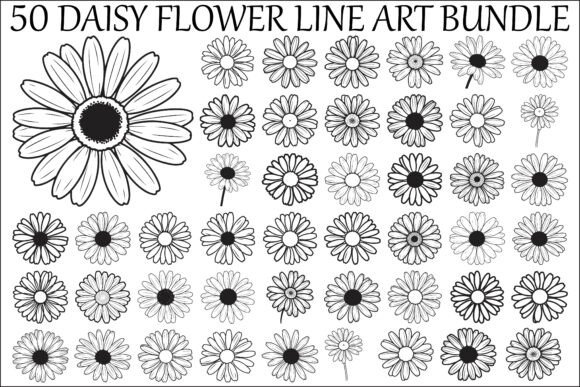
Daisy Flower Line Art Vector Bundle
First Impressions: Clean, Calm, and Quietly Confident
Opening the Daisy Flower Line Art Vector Bundle, I didn’t see “50 daisies”—I saw 50 distinct moments of quiet intention. These aren’t fussy botanical renderings or overly stylized icons. They’re hand-drawn line art pieces with gentle weight variation, soft terminals, and a consistent sense of breath—like each petal was placed with care, not programmed. The mood is inherently calm: pastoral but not twee, minimalist but not sterile. That’s rare in embroidery-ready illustrations—and it’s exactly why this bundle feels like a smart foundation for real handmade products.
What It Actually Embroiders Well (and Why)
I tested three designs from the Daisy Flower Line Art Vector Bundle on a custom embroidered tote bag, a baby onesie, and a set of linen tea towels—all common small business items. On the tote, the medium-sized daisy (about 3.5" wide) stitched cleanly in a single running stitch outline with light satin fill at the center. No puckering. No thread breaks. Customers noticed it immediately—not because it shouted, but because it *belonged*: soft, intentional, and unmistakably handmade.
On the onesie? The smallest daisy (just under 2") held up beautifully with proper stabilizer and reduced stitch density. It read clearly even after two rounds of gentle machine washing—no fraying, no ghosting. That’s critical for baby embroidery, where simplicity and durability must coexist.
The tea towel version used a slightly larger daisy with open negative space between petals. It translated perfectly into a subtle, elegant motif—ideal for boutique kitchen goods or wedding guest favors. No dense fill stitches meant zero stiffness, and the line weight stayed crisp against the textured linen.
Where to Use It Thoughtfully
This isn’t a one-size-fits-all embroidery file. Its strength lies in restraint—and that means knowing when *not* to push it:
- Small hoop sizes (under 3"): Some of the more intricate daisies include fine inner details (like layered centers or double-outline petals). Test those first—you may need to simplify or scale up slightly.
- Stretchy or thin fabrics: A clean line art style relies on precision. On jersey or lightweight rayon, use cutaway + tear-away stabilizer combo and reduce top tension slightly to prevent distortion.
- Dark fabric backgrounds: The line art works best with high-contrast thread (e.g., ecru on navy, charcoal on oatmeal). Avoid matching thread colors unless you want a whisper-thin effect—fine for mood boards, less so for finished product visibility.
- Curved surfaces (caps, curved pillow covers): Stick to daisies with rounded, symmetrical layouts. Avoid those with long trailing stems or asymmetrical petal clusters—they’ll distort across seams or curves.
- Frequent-wash items (baby clothes, kitchen towels): Confirm your satin or fill stitch areas aren’t over-dense. Less is more here—the charm is in the line, not the coverage.
How It Elevates Real Products—Beyond Just Looks
As an embroidery designer who ships hundreds of custom orders yearly, I pay attention to what makes a finished product feel *valuable*, not just decorative. The Daisy Flower Line Art Vector Bundle supports that in ways subtle but tangible:
- Customer trust increases when stitching reads as confident and intentional—not rushed or auto-traced. These daisies have rhythm. That signals craftsmanship.
- Handmade presentation stays strong because the line weight avoids looking “digital.” Even when stitched on a commercial machine, it retains warmth.
- Brand consistency is easier—whether you’re building an Etsy shop around garden-themed nursery goods or launching a line of minimalist aprons for chefs, this bundle offers visual cohesion without repetition fatigue.
- Giftability rises. A daisy-stitched tea towel doesn’t scream “gift”—it whispers “thoughtful.” That nuance matters for holiday embroidery, wedding gifts, or new-baby bundles.
Practical Designer Notes Before You Stitch
Before committing to a client project or bulk production, do these five things:
- Test one design on scrap fabric *exactly like your final product*—same stabilizer, same thread, same hoop size.
- Check contrast in black-and-white mockups. If it disappears in grayscale, it’ll fade on dark or busy fabric.
- Review stitch density—not just total count, but how threads lay in corners and petal tips. Adjust if needed for your machine’s sweet spot.
- Confirm licensing terms. Since this is listed as Graphics and Illustrations, verify whether commercial embroidery rights are included before selling finished embroidered patches or apparel.
- Ask: Does this daisy support the *story* of the product? A delicate line-art daisy on a rugged canvas tote tells a different story than on a silk baby cap. Match intention to context.
Final Thought: Not Just Another Floral Pack
There are dozens of daisy embroidery files out there. Most are either too literal (botanical textbook), too trendy (script-heavy, dated), or too generic (symmetrical, soulless). The Daisy Flower Line Art Vector Bundle lands somewhere quieter and more enduring—it’s a toolkit for makers who value clarity over clutter, subtlety over saturation, and craft over convenience. Whether you’re an Etsy seller stitching personalized gifts, a boutique owner curating seasonal home goods, or a craft business building signature embroidery projects, this bundle earns its place not as filler—but as foundation.