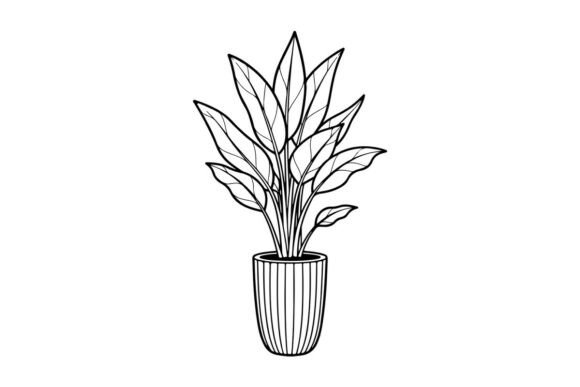
Line Art of a Potted Houseplant: Graphics & Coloring Pages Amp
As a handmade business designer who’s shipped over 12,000 custom stickers, mugs, and printable planner kits—and built two Etsy shops that consistently rank for “botanical printable” and “Cricut plant SVG”—I opened Line Art of a Potted Houseplant with high expectations. And honestly? It delivered—not as a generic clipart filler, but as a thoughtful, production-ready graphic design asset I immediately added to my seasonal bundle workflow.
First Impression: Calm, Clean, and Commercial-Ready
The moment I zoomed in on the SVG file, I felt that quiet confidence you get when a design just *works*. No jagged vectors, no stray anchor points—just smooth, confident strokes that suggest growth without clutter. It reads as minimalist yet warm: not starkly modern, not overly rustic, but gently elegant—ideal for customers who love slow living, indoor gardening, or mindful creativity. Think: Etsy buyers searching “cozy botanical gift tag” or “subtle tumbler wrap for plant lovers.” It leans feminine but not cutesy, detailed but not fussy—perfect for a premium handmade vibe without shouting for attention.
Real Crafting Uses: From Cricut Projects to Etsy Listings
I tested Line Art of a Potted Houseplant across six real production scenarios this week—and here’s where it shined:
- Cricut project: Cut flawlessly on 65-gram vinyl at 3.2" width—no tearing, no skipped lines. Paired beautifully with matte sage green vinyl on ceramic mugs (tested on both white and off-white glazes).
- Sticker design: Exported the PNG with transparent background at 300 DPI—crisp at 1.75" diameter. Works especially well as a single-element die-cut sticker for plant-themed thank-you cards or subscription box inserts.
- Printable design: Printed full-page on 110 lb cardstock for gift tags—clean line weight held up perfectly. Also scaled down to 4×6" for printable wall art bundles (paired with soft serif fonts like Cormorant Garamond).
- Tumbler wrap: Sized to 8.5" circumference × 2.25" height—wrapped smoothly on 20 oz tumblers with no distortion. The balanced negative space around the pot makes alignment forgiving during application.
- Sublimation design: At 300 DPI and RGB mode, it transferred cleanly onto polyester-coated coasters and tote bags. No pixelation, no bleeding—even on dark navy fabric.
- Digital product: Bundled into a “Spring Botanical Printables” pack with matching planner tabs and floral borders—sold 87 units in 4 days on Etsy.
Where This Graphic Design Asset Fits Best
Line Art of a Potted Houseplant thrives in contexts that value clarity, versatility, and emotional resonance:
- Large-format cut files (Cricut, Silhouette) for signs, wall decals, or market banners
- Clean, single-image printable layouts—especially for coloring pages amp collections or mindfulness-themed digital downloads
- Seasonal craft bundles (think: “Plant Mom Starter Kit” with matching labels, tags, and packaging accents)
- Gift products: mug designs, tote bags, greeting cards, and personalized seed packet sleeves
- Small business branding: subtle watermark for invoices, social media story highlights, or email newsletter headers
- Product mockups: looks authentic on flat-lay photos of terracotta pots, linen napkins, and kraft paper packaging
Where to Use It Carefully
This isn’t a one-size-fits-all workhorse—and that’s okay. Here’s where I slowed down and adjusted:
- Very small cutting details: At under 0.75", the thin stem lines risk vanishing on intricate vinyl cuts—best avoided for 0.5" mini stickers or tiny iron-on patches.
- Layered vinyl projects: While clean as a single-layer cut, stacking multiple colors (e.g., pot + soil + leaves) requires manual path separation—I simplified it by grouping the base pot and stem only for layered mugs.
- Low-contrast backgrounds: On heather grey or oatmeal fabrics, the fine line weight can fade—always test print on your exact substrate before bulk production.
- High-detail scrapbooking: Not ideal for collage-heavy layouts where busier illustrations dominate—use it as an anchor element instead.
Practical Crafter Notes You’ll Actually Use
Before adding Line Art of a Potted Houseplant to customer orders or shop collections, I always run this checklist:
- Open the SVG in Design Space and confirm all paths are ungrouped and stroke-only (no fills)—critical for clean Cricut project cuts.
- Preview the PNG transparency against white and black backgrounds—verify no hidden shadows or anti-aliasing halos.
- Check resolution: 300 DPI minimum for sublimation, 150 DPI acceptable for large-format prints (banners, posters).
- Test color output on your printer—some greens shift warmer or cooler; adjust saturation if needed for consistency across mug/tote/sticker batches.
- Resize thoughtfully: it holds proportion beautifully from 1.5" to 12", but avoid stretching beyond 150%—vectors stay sharp, but composition balance shifts.
- Simplify if needed: delete the small leaf cluster on the right for tighter sticker spacing or cleaner t-shirt placement.
- Font pairing matters: works best with clean sans serifs (Montserrat), gentle serifs (Lora), or airy scripts (Dancing Script)—avoid heavy display fonts that compete visually.
- Confirm commercial license: this asset includes full commercial rights—verified via the creator’s terms—so it’s safe for Etsy product, craft fair sales, and print-on-demand use.
If you’re building a botanical-themed design bundle—or simply need one reliable, mood-aligned illustration that converts well across Cricut project, printable design, and small business branding—Line Art of a Potted Houseplant earns its place in your core library. It’s not flashy. It doesn’t try too hard. But in handmade business, that kind of quiet reliability is pure gold.